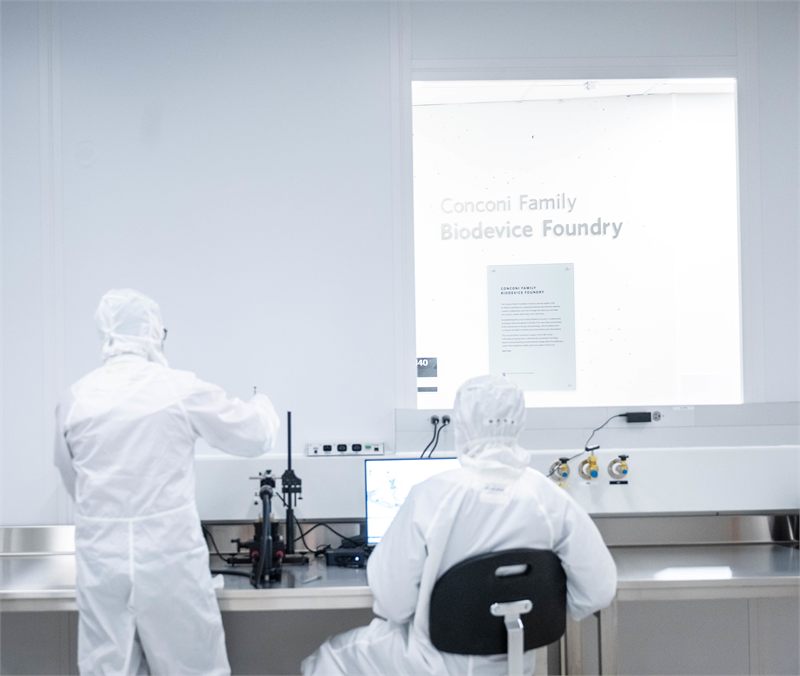
Meet the team
The Conconi Family Biodevice Foundry is supported by staff and leadership with expertise spanning microfabrication, microfluidics, surface chemistry, prototyping, and translational Biodevice development.

Huawei Li
Operations Manager
Dr. Huawei Li is the Operations Manager of the Conconi Family Biodevice Foundry, where he manages facilities dedicated to the design, fabrication, and characterization of microscale Biodevices. He earned his PhD in Physical Chemistry from the University of Calabria, Italy.
Dr. Li has worked extensively in both academic and industrial settings in design, fabrication, prototyping, and commercialization of microscale and nanoscale devices. His expertise spans microfluidics and nanofluidics, MEMS, thin film fabrication, and a wide range of fabrication and characterization techniques.
With a strong background in Biodevice fabrication, process development, and technology commercialization, he is committed to supporting academic and industry partners in accelerating innovations through the Conconi Family Biodevice Foundry.

Bob Perry
Engineering Technician
With more than a decade of experience building creative automation and manufacturing systems, Bob Perry has worked across aerospace, defense, and medical technology sectors to bring complex ideas into reality.
His work blends practical engineering with rapid iteration, helping teams turn early concepts into functional, tested solutions.
At the Conconi Family Biodevice Foundry, Bob leads the Rapid Prototyping Lab as an Engineering Technician. He partners with researchers, entrepreneurs, and early-stage companies to accelerate development in the microdevice and biomedical technology space.

Alexander Xu
Cleanroom Process Engineer
Alexander Xu is a Cleanroom Process Engineer at the Conconi Family Biodevice Foundry, where he is responsible for the operation, maintenance, and safe use of cleanroom equipment. He also supports user training and the development of cleanroom processes.
He graduated from the University of Waterloo with a Master of Applied Science in Electrical Engineering, specializing in nanotechnology. His thesis consisted of the fabrication and testing of graphene oxide biosensing platforms for the detection of DNA, COVID-19, and E. coli.
With expertise in microfabrication, thin-film processing, biosensor development, and materials characterization, Alexander supports researchers in developing and optimizing processes for a variety of cleanroom applications. He is particularly interested in helping users translate their research concepts into reliable and reproducible fabrication workflows. His favourite ice cream flavour is coffee.

Sofia Graham Arshavsky
Research Associate
Dr. Sofia Graham is a Michael Smith Health Research BC and Conconi Family Foundation Biodevice Innovation Fellow, supporting the Conconi Family Biodevice Foundry and leading research on Biodevice development for tumor-immune interaction modeling.
She completed a three-year postdoctoral fellowship in the Laboratory of Microtechnologies for Quantitative Biomedicine at SBME, where she specialized in microfluidic approaches to spatiotemporally model, manipulate, and characterize cancer heterogeneity using live-cell systems.
Trained as a biotechnology engineer, Dr. Graham holds a dual PhD from the Technion-Israel Institute of Technology and Leibniz University Hannover, where she developed microfluidic-assisted optical nanostructured biosensors for cancer diagnosis. She brings expertise in microfluidics, microfabrication, nanostructured semiconductors, surface chemistry, microscopy, and bioconjugation techniques.

Ulri Lee
Postdoctoral Fellow
Dr. Ulri Lee is a School of Biomedical Engineering Postdoctoral Fellow where she is developing biomedical countermeasures to equip the healthcare ecosystem with tools for improved medical response time and outcomes.
She was previously an MIT School of Engineering Distinguished Postdoctoral Fellow where her research focused on scaling organ-on-a-chip systems. Dr. Lee received her PhD in Analytical Chemistry from the University of Washington where she leveraged open microfluidics to develop 3D hydrogel patterning techniques, deployable bioaerosol samplers, and pumpless droplet generators.
She brings expertise in device fabrication, including machining, 3D printing, and injection molding, as well as microbial and mammalian cell culture and bioanalytical characterization techniques.

Govind Kaigala
Scientific Director
Dr. Govind Kaigala's interests are in the areas of microscale fluid control, microscale molecular assays, and technologies for personalized medicine. He is passionate about translational clinical and medical research.
He joined UBC in the summer of 2022. Previously he was at the IBM Research laboratory in Zurich for about 11 years, where he was a scientist and a principal investigator leading a team of researchers in the area of precision diagnostics.
He earned his PhD from the departments of Electrical and Computer Engineering and Oncology in 2009 from the University of Alberta, where he developed microfluidic systems for genetic analysis. He also completed an NSERC Postdoctoral Fellowship at Stanford University.